Before there was a treatment, there was a song. When Ronald Reagan still would not say the word "AIDS" out loud, when funeral homes turned bodies away, when hospitals kept dying people behind glass, our community did what our community has always done. We made art. We made music. We sang for the friends we were losing and we sang for the ones we were keeping. This is the story of that music — the pop hits and the requiems, the benefit records and the Broadway stages, the tribute concerts and the tiny cabaret rooms where sick men sang for sick men and refused to disappear quietly.
The soundtrack of the epidemic is not one song. It is dozens. Some of them raised millions of dollars when the government would not spend a cent. Some of them opened doors that policy could not. Some of them just gave a grieving family the words to say goodbye. Together they form a record of what our community did with grief and rage and love — and they are still on the radio, still on Broadway, still on streaming playlists we make for people we have never met but who need them the way we once did.
Nearly every song here was written by people directly touched by the epidemic — artists living with HIV, artists losing partners and friends, artists watching whole scenes vanish. That is why they still work. They are not about our community. They are from our community.
01 "That's What Friends Are For" · 1985
In the fall of 1985, Elizabeth Taylor had an idea. Her friend Rock Hudson had died in October. Hudson had been one of the first public figures to acknowledge an AIDS diagnosis, and his death forced a country that had spent four years looking away to look. Taylor had already helped found the American Foundation for AIDS Research — amfAR — and she needed money. She turned to her friends in the music business.[1]
What came out of that ask was one of the most successful benefit singles in pop history. "That's What Friends Are For," written by Burt Bacharach and Carole Bayer Sager, had first been recorded by Rod Stewart in 1982 to little notice. In 1985, Dionne Warwick recorded it again with Elton John, Gladys Knight, and Stevie Wonder as "Dionne and Friends," released as an amfAR benefit. It became Billboard's number-one single of 1986, and Bacharach and Sager won the 1986 Grammy for Song of the Year. It raised more than three million dollars for amfAR at a moment when private giving was one of the only sources of AIDS research money in America.[1]
Dionne Warwick said later that the song had been an avenue to reach people without stigma. It was not sold as an AIDS song. It was sold as a love song, and it was — and the money went to save lives. That trick, that Trojan-horse tenderness, would define AIDS benefit music for a decade. If you could get a country that would not look at us to listen to us, you could get some of them to give.
Taylor personally telephoned friends across the entertainment industry to pull together the amfAR benefit. She raised more than a hundred million dollars for HIV research and services in her lifetime, and she used her fame as a bludgeon. When she spoke, people picked up the phone. She spoke often.
02 Cyndi Lauper — "True Colors" and "Boy Blue" · 1986
Gregory Natal was one of Cyndi Lauper's closest friends. He was 24, and he was dying of AIDS. He asked her to write him a song — something in the spirit of "That's What Friends Are For." She tried. What came out of that grief was not one song but two.[2]
Lauper did not write "True Colors." Billy Steinberg and Tom Kelly did, and Steinberg had written it with his own mother in mind. But when Lauper first heard the demo, Natal had already died. She recorded the song in a whispered vocal that made the whole thing feel like a bedside conversation. In a 2023 interview with People, she told the story plainly:[2]
Released in August 1986, "True Colors" hit number one on the Billboard Hot 100 on October 25 of that year and stayed there two weeks. It was nominated for a Grammy for Best Female Pop Vocal Performance. But the pop success is not why it stayed. It stayed because it did what Lauper had asked it to do — it became a song people played for the friends they were losing, and then for the friends they were keeping. In 2025, Billboard ranked it number nine on its list of the one hundred greatest LGBTQ+ anthems of all time.[2]
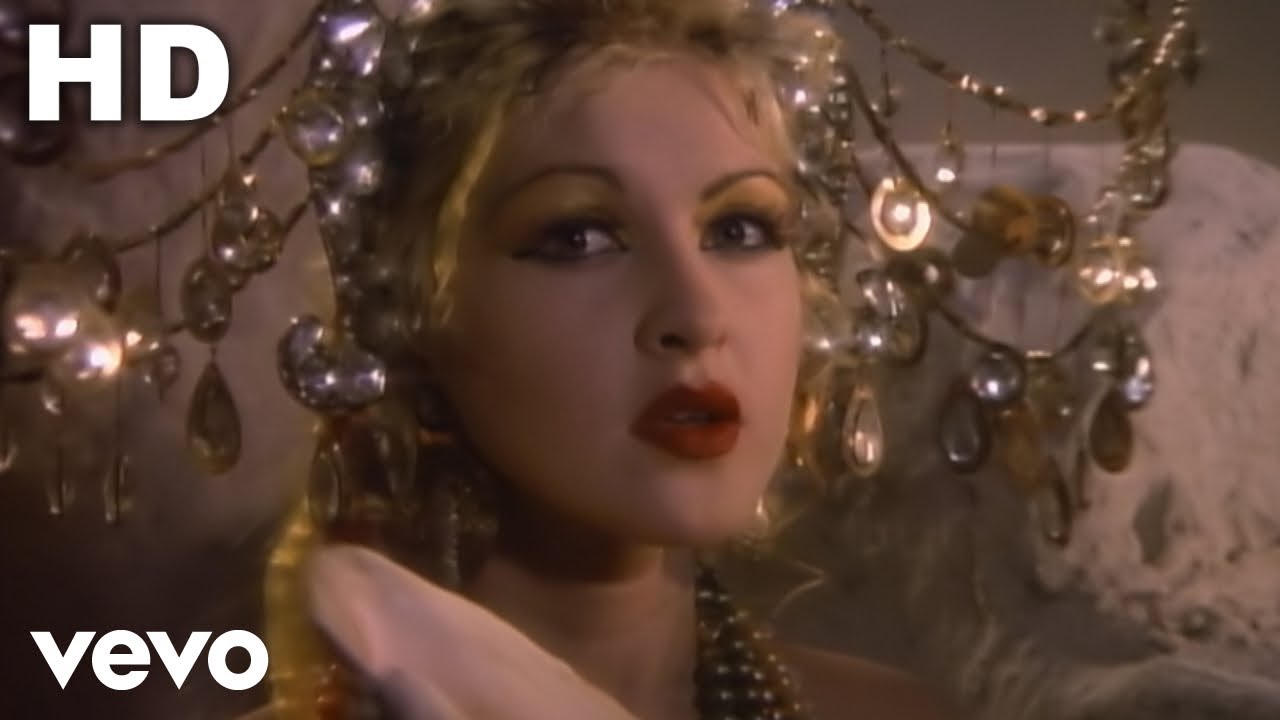
The song Lauper actually wrote for Natal is "Boy Blue" — the fourth single from the same album, released as a single on May 25, 1987. She co-wrote it with Stephen Broughton Lunt and Jeff Bova. It never reached the same heights as "True Colors" on the charts (peaking at number 71) and it has never been in the public conversation the way its album-mate has. But it is the song Natal specifically asked her to make.[2]
Lauper went on to found True Colors United in 2008, named for the song, to combat homelessness among LGBTQ+ youth. In December 2022 she performed "True Colors" at the White House at the signing of the Respect for Marriage Act. The song's life is long because its origin was tender. It was made for one person. A generation adopted it.[2]
03 Prince — "Sign O' the Times" · 1987
By 1986, more than 24,000 Americans had died of AIDS-related illness, and no mainstream rock or pop artist had led a single with the epidemic. Then Prince did.[3]
He recorded "Sign O' the Times" on July 15, 1986. According to Susannah Melvoin, his fiancée at the time, they were in Los Angeles when a 6.0 earthquake struck. "It scared the [expletive] out of him," she said. He grabbed the morning paper. She has recalled him staring at the front page of the Los Angeles Times and saying, "Something's happening to the world." He wrote the song that day.[3]
He released it as a single on February 18, 1987. The opening lines were a shock — no metaphor, no cushion:
By chance his girlfriend came across a needle and soon she did the same" — Prince, "Sign O' the Times," 1987
He never says the word "AIDS." He calls it "a big disease with a little name." From the first eight bars, the song is inside the epidemic — a Frenchman dying, a needle, a woman infected, a country not paying attention. From there it opens up: gang violence, the crack epidemic, the Challenger disaster, Reagan's Strategic Defense Initiative, a country that has quietly lost the plot. The song hit number three on the Billboard Hot 100 and number one on the Hot Black Singles chart. It is widely credited as the first major rock hit to open with the epidemic.[3]
What Prince did was not sentimental. It was journalistic. The song is a headline in a minor key — a Black artist at the peak of his powers pointing at a disease the White House would not name for another seven years, and pointing at every other place the country was quietly bleeding while it was pointing.
The four-word phrase from the opening verse became shorthand for the crisis in a country that would not use its actual name. Prince gave a national radio audience a way to talk about the epidemic without permission from the government to say the word.
04 Red Hot + Blue · 1990
In 1990, a compilation arrived that changed what an AIDS benefit record could be. The Red Hot Organization — founded that year by John Carlin and Leigh Blake — put out a tribute album called Red Hot + Blue. The premise was simple: contemporary artists reinterpreting the songs of Cole Porter, the queer American songwriter whose music sat at the heart of the twentieth-century pop songbook. The lineup was staggering. U2, Neneh Cherry, Sinéad O'Connor, Annie Lennox, k.d. lang, Erasure, Tom Waits, David Byrne, Iggy Pop and Debbie Harry, The Pogues with Kirsty MacColl, Jimmy Somerville, Jungle Brothers, Salif Keita. Most of the tracks were paired with music videos from directors like Jonathan Demme, Wim Wenders, Neil Jordan, and Jim Jarmusch. An accompanying television special aired on ABC in the United States and in more than 30 countries around the world.[4]
It sold more than a million copies and donated nearly a million dollars to ACT UP — money that, per the Red Hot Organization's own account, helped ACT UP and the Treatment Action Group push the drugs to market that now let people live with HIV. It was the first time the music industry produced an AIDS benefit as a serious cultural statement rather than a charity add-on.[4]
Red Hot went on to release nearly twenty follow-up compilations across the next three decades. But Red Hot + Blue is where the model was born: use the best living artists you can find, use the songs of a queer ancestor, put queer love back at the center of the pop canon, and give the money to the people fighting to keep us alive.
05 The Requiems · 1990–1991
Pop was one language. Concert halls were another. On March 15, 1990, the Chicago Symphony Orchestra — where John Corigliano was serving as the ensemble's first Composer-in-Residence — premiered his Symphony No. 1 under Daniel Barenboim. Corigliano had lost many friends and colleagues to AIDS, and after seeing the AIDS Memorial Quilt in the 1980s he wrote the symphony as a musical parallel: each of the first three movements dedicated to a specific musician friend he had lost. "My Symphony No. 1 was generated by feelings of loss, anger, and frustration," he wrote. The work won the Grawemeyer Award for Music Composition in 1990 and Grammys for Best Orchestral Performance and Best New Composition in 1991. It is one of the first major classical works to sit inside the epidemic rather than commemorate it from outside.[5]
Corigliano returned to the subject in 1991 with "Of Rage and Remembrance," a reimagining of the symphony's third movement as a ritual for community chorus, built around a litany of names of men lost to AIDS. "Its audience is not really the audience for choral music," he wrote. "Its audience is the community blighted by AIDS." Around the same time, the composer Diamanda Galás — whose brother Philip-Dimitri died of AIDS-related complications in 1986 — recorded her Plague Mass, a full liturgical work performed inside a cathedral, screamed at the ceiling. Her voice was a weapon. She called it an act of witness.[5]
These pieces do not always show up on playlists. They are not written to comfort. They are written so that a hundred years from now, when someone opens a symphony program, they will still know we were here.
06 Freddie & Wembley · 1991–1992
Freddie Mercury died on November 24, 1991, of bronchopneumonia caused by AIDS-related illness. He had confirmed his diagnosis publicly only the day before he died. The world lost one of its greatest rock vocalists overnight. His bandmates — Brian May, Roger Taylor, and John Deacon — along with Queen's manager Jim Beach, decided to organize a memorial concert that would celebrate Mercury's life and put AIDS awareness on the largest possible stage.[6]
The Freddie Mercury Tribute Concert for AIDS Awareness took place at Wembley Stadium in London on April 20, 1992 — Easter Monday. All 72,000 tickets sold out before a single performer had been announced. Nearly 100 artists performed, including Elton John, David Bowie, George Michael, Robert Plant, Annie Lennox, Roger Daltrey, Liza Minnelli, Metallica, Def Leppard, Guns N' Roses, and Extreme. Elizabeth Taylor gave a speech on AIDS. Elton John and Axl Rose sang "Bohemian Rhapsody" together. George Michael's cover of "Somebody to Love" from that night is still, decades later, one of the most watched live vocal performances anywhere online.[6]

The concert was broadcast to 70 nations and watched around the world. Every performer wore a red ribbon. Out of the event, Brian May, Roger Taylor, and Jim Beach founded the Mercury Phoenix Trust in Freddie's memory. The Trust remains active: its About page now reports funding 1,956 HIV/AIDS projects across 57 countries and distributing more than £17 million to charities working on the epidemic since 1992.[6]
Public-health messaging rarely reaches a global audience at all, let alone one this size. On Easter Monday 1992, an AIDS benefit did. Every viewer entering Wembley was given a red ribbon. For many of the people watching at home, it was the first time they had seen one.
07 Madonna — "In This Life" · 1992
Madonna had been burying friends for six years when she recorded "In This Life." Martin Burgoyne — the artist who designed her "Burning Up" sleeve, who had been her flatmate and one of her closest friends when she was a nobody in New York — had died on November 30, 1986. He was 23, if you take the song's lyric; he was 24, if you take TIME's 1987 report. Either way, he was a young man. Christopher Flynn, her childhood ballet teacher, had died of AIDS not long after. Both had been in her life since before anyone in America knew her name.[7]
She had been showing up before it was safe to. On July 13, 1987, at Madison Square Garden, Madonna dedicated her performance of "Live to Tell" to Burgoyne in front of nearly 17,000 people; that concert alone raised roughly $400,000 for the American Foundation for AIDS Research. TIME reported her onstage that night: "It feels great to be in a house full of people who care… AIDS is a strange and powerful disease. But we're more powerful." In 1989, she released Like a Prayer with an AIDS fact sheet tucked inside the sleeve — a first for a mainstream commercial release, calling AIDS "an equal opportunity disease" and calling for compassion and support for people living with it. She did that at the height of her fame, when the White House still could not.[7]
Her longtime collaborator Shep Pettibone had an idea for the 1992 Erotica album: a song for Martin. He wrote the chords. She wrote the lyrics in fifteen minutes. The song, "In This Life," became track twelve on an album framed by many critics as a concept record about sex and romance in the time of HIV/AIDS. It samples Gershwin's blues lullaby "Prelude No. 2" from 1926. It is quiet where the rest of the album is loud. It is, at heart, an elegy.[7]
On the Girlie Show tour in 1993, "In This Life" closed the middle act of the show, Madonna alone onstage in a plain white shirt. UPI's Sydney correspondent filed a dispatch on October 15, 1993 describing what happened at that point in the show: "The star goes on to speak of all the friends she has lost to AIDS and sings a touching and intense 'In This Life' as a blue clown with a white mask watches her from atop a dunce stool." Ten days later, in her hometown near Detroit, she dedicated a song at The Palace of Auburn Hills to her ballet teacher and to others she had lost.[7]
Thirty years later, on the 2023 Celebration Tour, "In This Life" returned — not as a full performance but as an intermission, its opening verse leading into "Live to Tell" while images of people who had died of HIV/AIDS were projected behind her. She had been carrying her friends around the world for thirty-seven years. She was still.[7]
Madonna described people who died as friends she had lost — not as "victims," and not as "AIDS patients." The language mattered then. It still does. On RiseUpToHIV, we talk about people who died of AIDS-related illness, and about people living with HIV.
08 Elton John and "The Last Song" · 1990–1992
Elton John kept a bedside vigil with Ryan White's family in Indianapolis in the final week of Ryan's life, and he was there when Ryan died on April 8, 1990. Ryan was 18. He had acquired HIV through contaminated clotting factor at 13 and had spent the second half of his short life turning stigma into a national conversation. Three days later, at Ryan's funeral at Second Presbyterian Church in Indianapolis, Elton served as a pallbearer, performed his own "Skyline Pigeon" at the piano, and led the congregation in the Lord's Prayer. The Los Angeles Times noted the moment in its dispatch that day.[8]
Elton has said repeatedly that Ryan and Jeanne White saved his life. He has credited the funeral as the catalyst for his own sobriety.[8]
In 1992, Elton and his longtime lyricist Bernie Taupin released "The Last Song," the closing track on the album The One. The song tells the story of a young man dying of AIDS whose estranged father comes at last to his bedside. The proceeds from the U.S. single went to AIDS charities, and it became one of Elton's early public gestures of a life reshaped by the epidemic.[8]

That same year, Elton founded the Elton John AIDS Foundation. In the decades since, it has become one of the largest independent funders of HIV work on the planet, delivering testing, prevention, and treatment funding across dozens of countries each year — much of it aimed at LGBTQ+ people, young people, people who use drugs, and other groups mainstream funders have historically ignored. In 2025 alone the Foundation reported reaching more than 523,000 people with lifesaving care across 68 countries.[8]
The Ryan White HIV/AIDS Program, named for that same eighteen-year-old, is now the largest federal program in the United States focused exclusively on HIV care. Its four parts fund care and services for more than half a million people living with HIV in the U.S. every year — the largest concentration of them in southern states, including Florida.[8]
09 Streets of Philadelphia · 1993
In 1993, Jonathan Demme released Philadelphia — the first big-studio American film to put a gay man with AIDS at its center, played by Tom Hanks. Demme wanted a song that would let the audience sit inside the character's head. He asked Bruce Springsteen and Neil Young both. Both delivered.[9]
Springsteen's "Streets of Philadelphia" was released as a single in 1994. On March 21, 1994, it won the Academy Award for Best Original Song — making Springsteen the first rock artist to win in that category. At the 37th Grammy Awards it won four awards: Song of the Year, Best Rock Song, Best Male Rock Vocal Performance, and Best Song Written Specifically for a Motion Picture or for Television. It spent 15 weeks in the Top 40, Springsteen's longest run since "Dancing in the Dark" nearly a decade earlier. What made it work was not spectacle — it was the opposite. Springsteen sang in a fragile, exhausted half-voice. He sounded like a man walking home from a hospital. He gave a mainstream American audience a first-person view of what it was like to live inside a body the world was already grieving.[9]
Neil Young also contributed a song, "Philadelphia," to the same film. When Springsteen accepted his Oscar he thanked Neil from the stage. Two of the most influential American songwriters of their generation, side by side, both writing about our community in 1993. It mattered.[9]
10 George Michael — "Jesus to a Child" · 1996
George Michael met Anselmo Feleppa, a Brazilian dress designer, at Rock in Rio in January 1991. Feleppa was in the audience. Michael was on the stage. They found each other after the show. Six months in, Feleppa learned he was HIV-positive; Michael later said the fear of losing him in an era before effective treatment was the hardest thing he had ever carried. Feleppa died in March 1993 of an AIDS-related brain haemorrhage. Michael did not write another song for eighteen months.[10]
When the block finally broke, the song came in a couple of hours. It was recorded across five days. It has a bossa nova rhythm — a Brazilian form for a Brazilian love. Michael premiered it live, in front of a global audience, at the first-ever MTV Europe Music Awards at Berlin's Brandenburg Gate on November 24, 1994. "Jesus to a Child" was released as the first single from Older on January 8, 1996. It entered the UK Singles Chart at number one — his sixth UK number one — and it peaked at number seven on the U.S. Billboard Hot 100, at the time the highest new U.S. entry by a British artist in more than twenty-five years.[10]
Michael did not talk publicly about Feleppa for years — he came out publicly only in 1998, on CNN, days after his Beverly Hills arrest — but he dedicated "Jesus to a Child" to Feleppa at every live performance until his own death in 2016. Michael's mother died of cancer the year after Feleppa did; the whole of the Older album is a tribute to Anselmo. When Michael died on Christmas Day 2016, the founder of ChildLine, Dame Esther Rantzen, revealed that Michael had quietly donated all of the single's royalties to the children's charity for two decades. Rantzen: "George helped us to reach out to hundreds of thousands of children through his generosity… It was an intensely personal gift. He didn't want it to be known or to be part of his image."[10]
He had been writing checks quietly for a long time. He recorded "Too Funky" in 1992 as a contribution to Red Hot + Dance, an AIDS-benefit compilation, and gave his royalties away. He wrote a song for the man he loved and gave the money to the children of strangers. That is a life.
11 Rent and Broadway Cares · 1996
Jonathan Larson worked as a waiter at the Moondance Diner in Manhattan for years while he wrote his musical. He was 35. He had lost close friends to AIDS. He rewrote Puccini's La bohème, moved it to the East Village, and swapped tuberculosis for HIV. He called it Rent. It went into previews at New York Theatre Workshop in January 1996.[11]
The night before the first preview, Larson died of an undiagnosed aortic aneurysm. He never saw an audience react to his show. The cast performed the first preview as a memorial reading. The song "Seasons of Love" stayed in the show and became its anthem — a song about counting a year of a young life in coffee cups, in strangers, in inches, in miles, in laughter and strife. In love.[11]
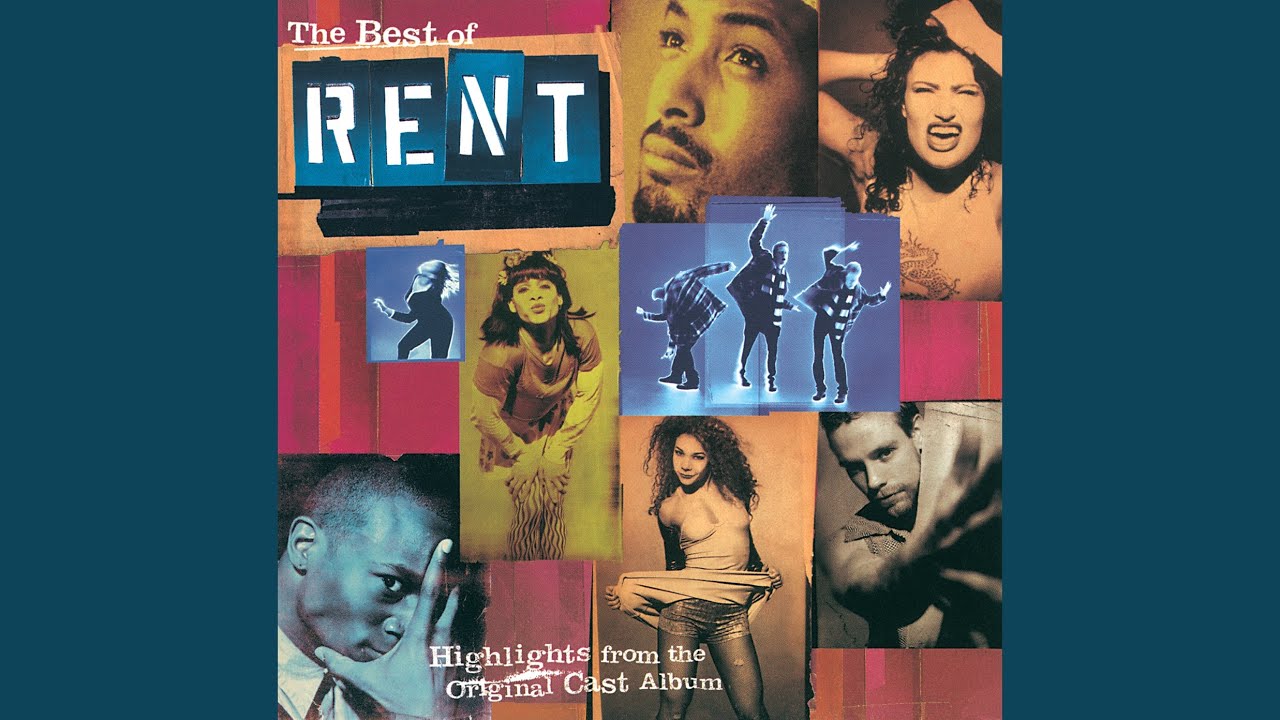
Rent transferred to Broadway that April. It won the 1996 Pulitzer Prize for Drama, and at the 1996 Tony Awards it took Best Musical, Best Book of a Musical, and Best Original Score — all posthumous for Larson — plus Best Featured Actor in a Musical for Wilson Jermaine Heredia. It ran on Broadway for twelve years. For a generation of teenagers in the mid-1990s and 2000s, "Seasons of Love" was the first song they ever heard that mentioned HIV, and it did so without pity or fear.[11]
Rent was one of many Broadway shows that raised money for people living with AIDS through Broadway Cares/Equity Fights AIDS, formed by the 1992 merger of two theater-community relief efforts founded in 1987 and 1988. Nearly every Broadway performance you attend in the United States ends with a curtain-call ask for BC/EFA. Since 1988, the organization has awarded more than $320 million for services for people living with HIV/AIDS and other critical illnesses, funding programs in all 50 states, Puerto Rico, and Washington, D.C.[12]
If you have ever seen a Broadway show, you have probably seen the cast come back out after the bows with red plastic buckets and speak briefly about Broadway Cares/Equity Fights AIDS. That thirty-second ask has funded a national safety net. Six-week runs. Long-running blockbusters. Off-Broadway. Touring companies. Every ticket, every night — more than three hundred and twenty million dollars, one bucket at a time.
Around Rent, other Broadway works were doing similar work in more explicit registers. Tony Kushner's two-part play Angels in America, subtitled "A Gay Fantasia on National Themes," opened on Broadway in 1993. Its first part, Millennium Approaches, won the 1993 Pulitzer Prize for Drama — awarded for a play the Pulitzer board described as delving "into the AIDS crisis as a symbol of moral decline during the 1980s." The play sat squarely inside AIDS-era New York, inside Roy Cohn's dying, inside a young man's diagnosis, and inside an angel crashing through a Manhattan bedroom ceiling.[13]
The cabaret and off-Broadway worlds carried their share. The singer-songwriter Michael Callen was one of about a dozen men living with AIDS who drafted the 1983 Denver Principles, the document that recast people with AIDS as human beings with rights and demands — "We condemn attempts to label us as 'victims,' which implies defeat, and we are only occasionally 'patients,' which implies passivity, helplessness, and dependence upon the care of others. We are 'people with AIDS.'" He co-founded the People With AIDS Coalition, co-wrote the seminal 1983 safe-sex tract How to Have Sex in an Epidemic, and recorded and performed as a solo artist and with the a cappella group The Flirtations until his death in 1993 at age 38. His posthumous album Legacy was released in 1996. He sang the truth about living inside an epidemic in a voice trained on Motown, and he did it for a decade.[14]
12 The Songs Today
The music did not stop. It changed shape. In 1993, Melissa Etheridge released "Silent Legacy" on her album Yes I Am — a song about the shame the world tries to hand queer kids and what it costs them. It is not directly an AIDS song, but it is the sound of the same years — an out lesbian rock star singing about inherited silence while the epidemic raged. Around the same time, MAC Cosmetics launched its VIVA GLAM lipstick, with every cent of the selling price going to HIV/AIDS programs through the MAC AIDS Fund. VIVA GLAM has raised hundreds of millions of dollars in the decades since.[15]
In the 2010s and 2020s, a new generation started writing our songs. Todrick Hall built entire visual albums around Black queer life. MNEK, a Black British queer producer, put queer joy on top-40 tracks that people danced to without needing a lecture attached. The ballroom world's return to mainstream pop — through artists like Beyoncé's Renaissance, Kim Petras, and the many artists who have sampled Kevin Aviance and Cakes da Killa — carried the sound of the scene that lost so many people in the 80s and 90s into the ears of teenagers who had never been told that story. That, too, is a form of remembrance.
The music today doesn't always announce itself. It doesn't have to. Undetectable equals untransmittable is a fact, not a slogan, and the songs written now are made by people who came up in a world where that fact is the water they swim in. Grief is still there. So is joy. So is dancing.
13 Undetectable = Untransmittable
Every song in this piece was written in a world where HIV was often a death sentence. That world is not the world we live in. A person living with HIV who takes modern treatment consistently, reaches an undetectable viral load, and stays there cannot transmit HIV sexually to another person. Not "low risk." Not "very unlikely." Zero risk. That is Undetectable = Untransmittable, or U=U, endorsed by the CDC, NIH, HIV.gov, and more than a thousand health organizations in over a hundred countries.[16]
The songs on this list were written for a country that did not yet know that. They still matter. They matter because they got us to the country that does. If you are newly diagnosed and reading this, the songs of the epidemic are your inheritance, not your fate. Modern treatment works. You can live a long life. You can love the people you love. Your community fought for that. Play the music loud.
Sixteen songs. Forty years. Play them loud.
Every song in this piece, in order. Every link goes to the artist's official channel or the licensed rights-holder. Nothing here is a fan reupload.
15 References & Sources
- ↩ ↩ "That's What Friends Are For" and Elizabeth Taylor's role initiating the amfAR benefit single. amfAR, "A Tribute to a Legend." POZ, "Dionne Warwick, Solid Gold HIV Advocate" (confirms >$3M raised for amfAR).
- ↩ ↩ ↩ ↩ ↩ Cyndi Lauper on "True Colors," Gregory Natal, and "Boy Blue." People via Yahoo Entertainment, "Cyndi Lauper Says She Recorded 'True Colors' After Losing Best Friend to AIDS" (all verbatim Lauper quotes). Cyndilauper.com, 35th Anniversary of "True Colors" (chart, Grammy nominations, album). Billboard, The 100 Greatest LGBTQ+ Anthems of All Time (rank #9, published June 4, 2025). True Colors United, About. Cyndilauper.com, White House performance, December 13, 2022. American Songwriter, "The Heartbreaking Story Behind Cyndi Lauper's 'True Colors'" (Steinberg/Kelly songwriting context; "Boy Blue" as the song written for Natal).
- ↩ ↩ ↩ Prince, "Sign O' the Times" (1987). Ultimate Prince, Susannah Melvoin on the Los Angeles earthquake and the front-page moment (quoting the Prince: The Story of Sign O' the Times podcast). NPR, "My American Dream Sounds Like Prince's 'Sign O' The Times'" (context on the song as opening the AIDS conversation in mainstream pop). U.S. HIV surveillance history — mortality by year — CDC, First 500,000 AIDS Cases — United States, 1995.
- ↩ ↩ Red Hot Organization and Red Hot + Blue (1990). Red Hot: Our History and Red Hot + Blue project page (confirmed track/artist pairings: U2 — "Night and Day"; Neneh Cherry — "I've Got You Under My Skin"; David Byrne — "Don't Fence Me In"). Additional context: POZ, "Red Hot Reissues AIDS Benefit Albums of the 1990s."
- ↩ ↩ John Corigliano, Symphony No. 1 (composed 1988–1989; premiered Chicago Symphony Orchestra under Daniel Barenboim, March 15, 1990) and "Of Rage and Remembrance" (1991). John Corigliano, Symphony No. 1 and Of Rage and Remembrance. TheBody, "New York Philharmonic Plays Symphonic Response to the AIDS Crisis."
- ↩ ↩ ↩ The Freddie Mercury Tribute Concert for AIDS Awareness (Wembley Stadium, April 20, 1992) and the Mercury Phoenix Trust. Mercury Phoenix Trust, About Us (1,956 HIV/AIDS projects across 57 countries; more than £17 million distributed since 1992). New York Times, "AIDS Benefit Concert Draws 72,000" (72,000 attendees; broadcast to 70 nations). Grammy.com, "Queen to Stream Freddie Mercury Tribute Concert 1992."
- ↩ ↩ ↩ ↩ ↩ Madonna, "In This Life," from Erotica (Maverick / Sire, 1992); Martin Burgoyne, Christopher Flynn, amfAR benefit at Madison Square Garden (July 13, 1987), and the Like a Prayer AIDS insert. TIME, "Show Business: How Artists Respond to AIDS" (contemporaneous report on MSG benefit; ~$400,000 raised for amfAR; Burgoyne age 24; Madonna onstage speech). UPI, "Madonna Bounces Back, Not Out" (October 15, 1993 — contemporaneous account of "In This Life" and AIDS remarks on the Girlie Show tour). Deseret News, "Madonna's Homecoming Includes Song to Teacher" (Auburn Hills dedication).
- ↩ ↩ ↩ ↩ ↩ Elton John, Ryan White, and the Elton John AIDS Foundation. Los Angeles Times, "1,500 Attend Ryan White Funeral in Indianapolis" (April 11, 1990 — Elton performs "Skyline Pigeon" and leads the Lord's Prayer). Elton John AIDS Foundation, Our History and home page (523,000 people reached across 68 countries in 2025). HRSA, About the Ryan White HIV/AIDS Program (largest U.S. federal program focused exclusively on HIV care).
- ↩ ↩ ↩ Bruce Springsteen, "Streets of Philadelphia," from the soundtrack to Philadelphia (1993). Springsteen official site, "And the Oscar Goes To..." (Best Original Song, March 21, 1994; 15 weeks in the Top 40). Recording Academy, 37th Annual Grammy Awards (four Grammy wins).
- ↩ ↩ ↩ George Michael, "Jesus to a Child" (1996) and Anselmo Feleppa. Smooth Radio, "George Michael's Secret ChildLine Donation" (Dame Esther Rantzen's statement about all "Jesus to a Child" royalties being donated). The Mirror, George Michael and Anselmo Feleppa (meeting at Rock in Rio 1991; Feleppa's death in 1993). CNN, Michael's 1998 CNN interview with Jim Moret (public coming out).
- ↩ ↩ ↩ Jonathan Larson and Rent (1996). The Pulitzer Prizes, 1996 Drama winner: Jonathan Larson for Rent. Tony Awards, 1996 Tony Awards winners.
- ↩ Broadway Cares/Equity Fights AIDS. Our Grants (lifetime total $323,399,175 since 1988; funding programs in all 50 states, Puerto Rico, and Washington, D.C.).
- ↩ Tony Kushner, Angels in America: A Gay Fantasia on National Themes. The Pulitzer Prizes, 1993 Drama winner: Tony Kushner for Angels in America: Millennium Approaches. New York Times, "Pulitzer Prize to a Play on AIDS and the 1980's."
- ↩ Michael Callen — the Denver Principles (1983), the People With AIDS Coalition, and his music. TheBody, "Late Musician and AIDS Activist Michael Callen Honored." New York Times obituary, "Michael Callen, Singer and Expert On Coping With AIDS, Dies at 38."
- ↩ Melissa Etheridge, "Silent Legacy," track 4 on Yes I Am (Island, 1993). MAC Cosmetics VIVA GLAM and the MAC AIDS Fund: maccosmetics.com/viva-glam.
- ↩ Undetectable = Untransmittable (U=U). CDC, "Ways HIV Is Not Transmitted." HIV.gov, "HIV Treatment as Prevention." Prevention Access Campaign, preventionaccess.org.